01
THE LAND
Where the mountains step aside for the jungle
Most people who have never visited Nepal imagine snow-covered peaks, dramatic ridgelines, and Mount Everest rising against a clear blue sky. While that image is certainly true, it tells only part of Nepal's story. Journey south from the Himalayas, beyond the charming hill towns and terraced hillsides, and the landscape transforms completely. The mountains gradually give way to the Terai a warm, lush, and river-fed lowland that surprises many visitors who never imagined this side of Nepal existed.
This is where Nepal’s jungle safari business actually lives. The Terai is a belt of sal forest, elephant grass taller than a person, oxbow lakes, and slow brown rivers that has shaped its own national park system: Chitwan, Bardia, Shuklaphanta, Parsa, Koshi Tappu. Chitwan alone, gazetted in 1973 as Nepal’s first national park and recognized by UNESCO as a World Heritage Site in 1984, spans nearly 953 square kilometres of forest and grassland inside the wider Terai Arc Landscape, one of Asia’s most biologically dense corridors. Within that single park, researchers have recorded roughly 68 species of mammals, 544 species of birds, 56 reptiles and amphibians, and 126 species of fish.
For a business owner, this geography is not just scenery, it is the product. A safari operator in Sauraha or Bardia is not selling a room with a view. They are selling access to one of the last great lowland wildernesses in South Asia, and that is a genuinely rare thing to sell.
02
THE WILD ENCOUNTER
What is actually waiting in the grass
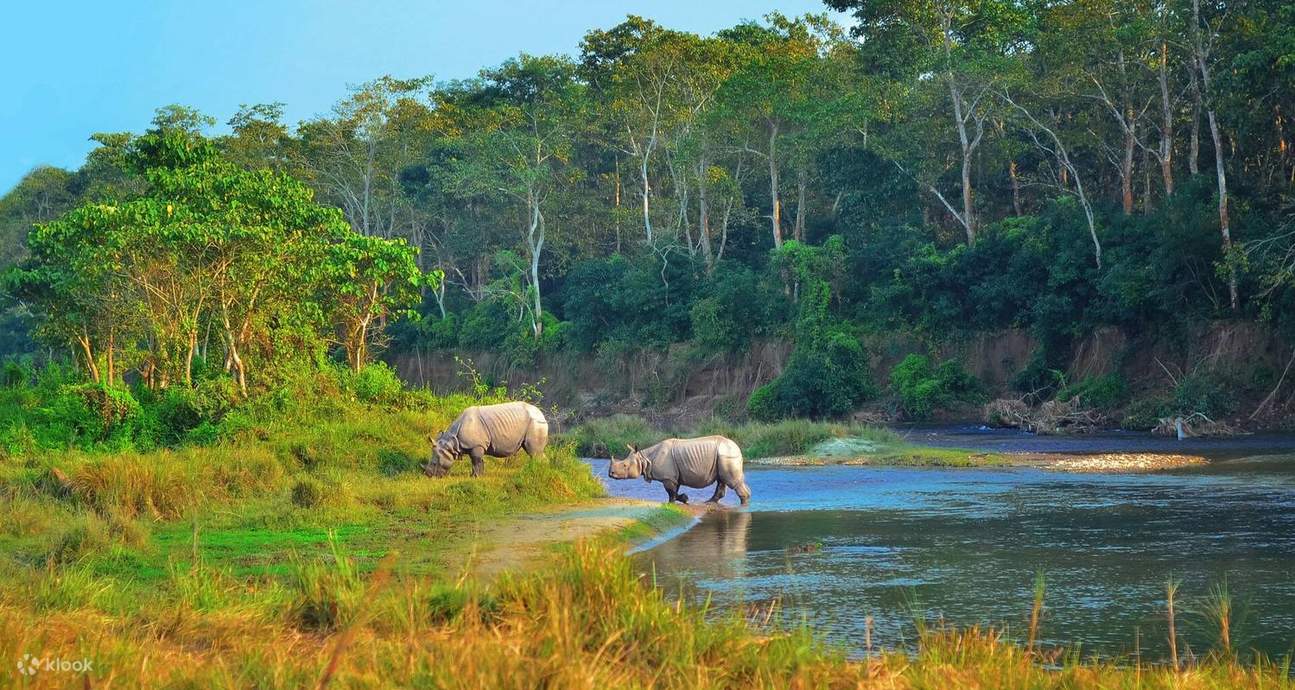
The single biggest draw of a Nepali jungle safari is the greater one-horned rhinoceros, and the comeback story attached to it. By the early 1970s, decades of hunting and habitat loss had pushed the population down to barely 100 animals confined to the Chitwan valley. Strict protection, round-the-clock patrols, and community-led conservation have since rebuilt that number to more than 700 individuals today, one of the clearest wildlife recovery stories anywhere in the world. Layered on top of that is a Bengal tiger population now estimated at around 128 in Chitwan alone, gharial crocodiles basking on the riverbanks, sloth bears, gaur, and a bird list long enough to draw ornithologists chasing species like the Bengal florican and the giant hornbill.
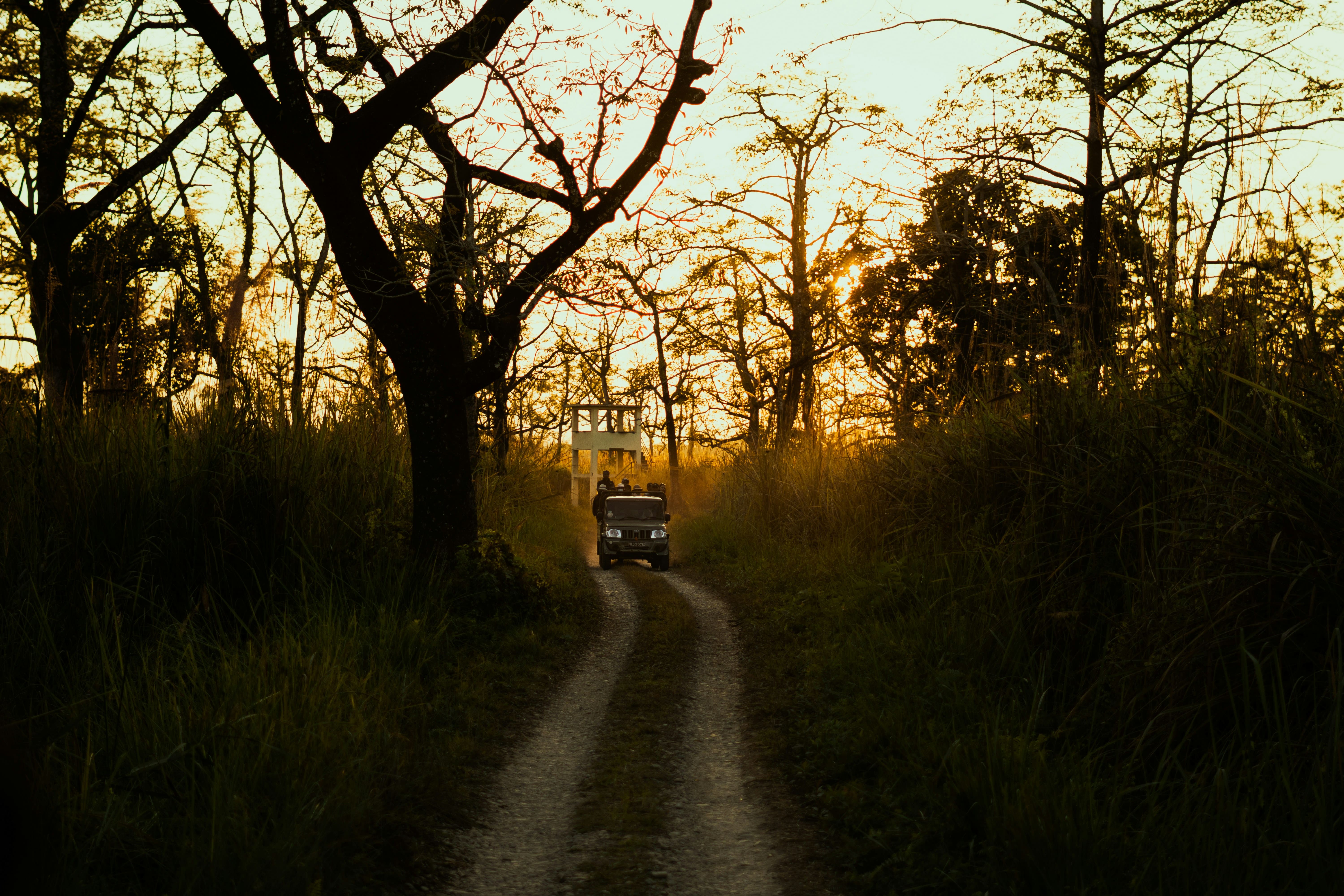
None of this is viewed from behind glass. A Nepali jungle safari feels closer to genuine wilderness: open-topped jeep drives through tall grass, dugout canoe rides down the Rapti or Karnali, guided walks led by naturalists who read pugmarks and droppings the way other people read road signs, and Tharu cultural performances in the evening that connect the wildlife to the indigenous community that has shared this land with it for generations. Elephant experiences have also shifted for the better in recent years, moving away from elephant-back rides toward mahout-led walking encounters with stronger welfare standards a detail worth highlighting prominently to today’s more conscious traveler.
"There's a closeness between the river, the forest, and the people who guide you through it that a brochure can never quite capture you only understand it once you are standing in the grass."
A safari guide in Sauraha, on what keeps visitors coming back
03
THE RHYTHM OF THE YEAR
Reading Nepal’s seasons like a guide does
A jungle safari business runs on weather in a way most businesses do not, and a marketing calendar that ignores this wastes its budget. The dry season, roughly October through March, is peak season: cool mornings, manageable heat, and easy road access. February and March specifically follow the controlled burning of tall grasslands, which thins the vegetation and makes wildlife noticeably easier to spot exactly the kind of detail worth turning into blog content, since travelers actively search for phrases like “best time to see tigers in Chitwan.”
April and May turn hot and dry, which is uncomfortable for some travelers but excellent for sightings, since animals cluster around shrinking waterholes. June through September brings the monsoon: rivers rise, grass grows lush and green again, and visitor numbers fall sharply. This is precisely the gap that smart pricing, shoulder-season photography content, and birdwatching-focused packages can fill, rather than leaving the gate quiet for four months a year.
04
THE BOOKING JOURNEY
How a tourist actually finds and books a safari
Picture the realistic path a traveler takes before they ever set foot in Sauraha or Thakurdwara. It rarely starts with a phone call. It starts with a search “Chitwan jungle safari package,” “Bardia National Park tour,” “best jungle safari near Kathmandu” or with a short video on Instagram or TikTok showing a rhino crossing a dirt road at dawn. From there, the traveler compares photos, reads reviews on Google or TripAdvisor, checks whether the business is listed on platforms like GetYourGuide or Booking.com, and only then looks for a way to lock in dates.
At that final, most important step, many genuinely excellent Nepali safari businesses lose the booking simply because there is no clear way to reserve a spot, confirm a price in advance, or pay online through eSewa, Khalti, or an international card. Every one of those friction points is a place where a stronger digital presence turns a curious browser into a paying guest.
05
THE ECONOMY
Why one booking ripples far beyond the gate
A single safari booking does more economic work than it looks like on the surface. Nationally, travel and tourism is estimated to contribute somewhere around 7–8% of Nepal’s GDP and to support well over a million jobs, directly and indirectly a picture made more visible by 2024’s tourist arrivals crossing 1.14 million, a rise of more than 13% year on year, as the government’s Tourism Decade 2023–2032 campaign pushes toward a target of 3.5 million annual visitors.
At the park level, the same pattern repeats in miniature. Chitwan’s buffer-zone community forests welcomed over 168,000 visitors in just the first eight months of one recent fiscal year, generating more than NPR 175 million in revenue in that window alone money that flows directly back into anti-poaching patrols, habitat restoration, and community development. Behind every jeep, canoe, and guided walk sits a small, visible economy: naturalist guides, drivers, lodge and homestay staff, cooks, Tharu cultural performers, handicraft sellers, and the boatmen who ferry guests across the river at dawn. A safari business that grows its bookings is not just growing a private company, it is widening the income base of an entire Terai community.
|
TOURISM, BY THE NUMBERS |
|
|
Tourism’s estimated share of Nepal’s GDP |
~7–8% |
|
Jobs supported nationally by tourism |
1M+ |
|
International arrivals in 2024 |
1.14M+ (+13% YoY) |
|
Visitors to Chitwan’s buffer zone, 8 months |
168,000+ |
|
Nepal’s targeted annual arrivals by 2032 |
3.5M |
06
THE GAP
Why great safaris still go unbooked.
Talk to enough operators in Sauraha, Thakurdwara, or along the Koshi Tappu corridor, and a familiar pattern appears. The product is genuinely excellent, often family-run for two generations, with guides who know the forest better than any app ever could. What’s missing is almost never the experience itself it’s the digital path that leads a stranger on the other side of the world to it. The most common gaps:
- No website, or one that hasn’t been updated since it was first built.
- A site that isn’t readable on a phone, even though most travel research now happens on one.
- No real search visibility, so the business never appears for “jungle safari Nepal” or “Chitwan safari packages".
- Total dependence on walk-in agents and OTA commissions that quietly take 10–20% off every booking.
- Inconsistent or outdated social media, with no consistent content calendar.
- No way to confirm or pay for a booking online.
- Content written only in English, when a meaningful share of demand is domestic, Indian, or Chinese.
07
THE DIGITAL EDGE
Turning visibility into bookings
The fix for nearly every gap above is the same: build the digital presence with the same care that goes into training a good naturalist guide. In practice, that means:
- A genuinely SEO-optimised website, with keyword-rich pages for each park, season, and itinerary.
- A regularly updated blog the very format of this article built around real searches like “best time for Chitwan safari” or “Bardia vs Chitwan, which is better".
- An integrated booking and payment system supporting eSewa, Khalti, and international cards, so a traveler can check availability and pay in one sitting instead of waiting days for a reply.
- A short-form video strategy for Instagram Reels, YouTube Shorts, and TikTok now where many travelers discover a destination before they ever open Google.
- A claimed, optimised Google Business Profile, so the business shows up with reviews, photos, and hours for “jungle safari near me” searches.
- Multilingual content for the markets that already send the most visitors.
- Structured schema markup running quietly behind the page, so search engines can surface rich results like ratings and pricing directly in the listing.
None of this replaces the guide standing in the grass at dawn. It simply makes sure the traveler finds that guide in the first place.
THE PARTNERSHIP
Building the digital home your safari deserves
This is the part of the business most safari operators in Nepal were never trained for and it’s exactly the part Rewa Soft exists to handle. We design and build custom websites and booking-ready web and mobile applications for travel and hospitality businesses across Nepal. The same instinct that goes into mapping a jungle trail goes into mapping a customer’s path from a search bar to a confirmed reservation. Combined with our SEO and content writing services, branding, and ongoing maintenance support, the goal is simple: when someone, anywhere in the world, searches for a jungle safari in Nepal, your business should be the one they find first and the easiest one to book.
“Praise for a destination travels fast on social media. What keeps a guest coming back, and bringing friends, is whether the booking experience matched the story they saw online.”
Team Rewa Soft