The Man Who Keeps Going Back to Everest
01 - ORIGINS
A boy from Thame, where mountains are gods
Kami Rita Sherpa was born on January 17, 1970, in Thame a small village hidden deep in Nepal's Solukhumbu district, at an altitude where the air is already thin and the Himalayas are not a Scenery but a way of life. He grew up in the same village that gave the world Tenzing Norgay, the man who first stood at top of Everest with Edmund Hillary in 1953.
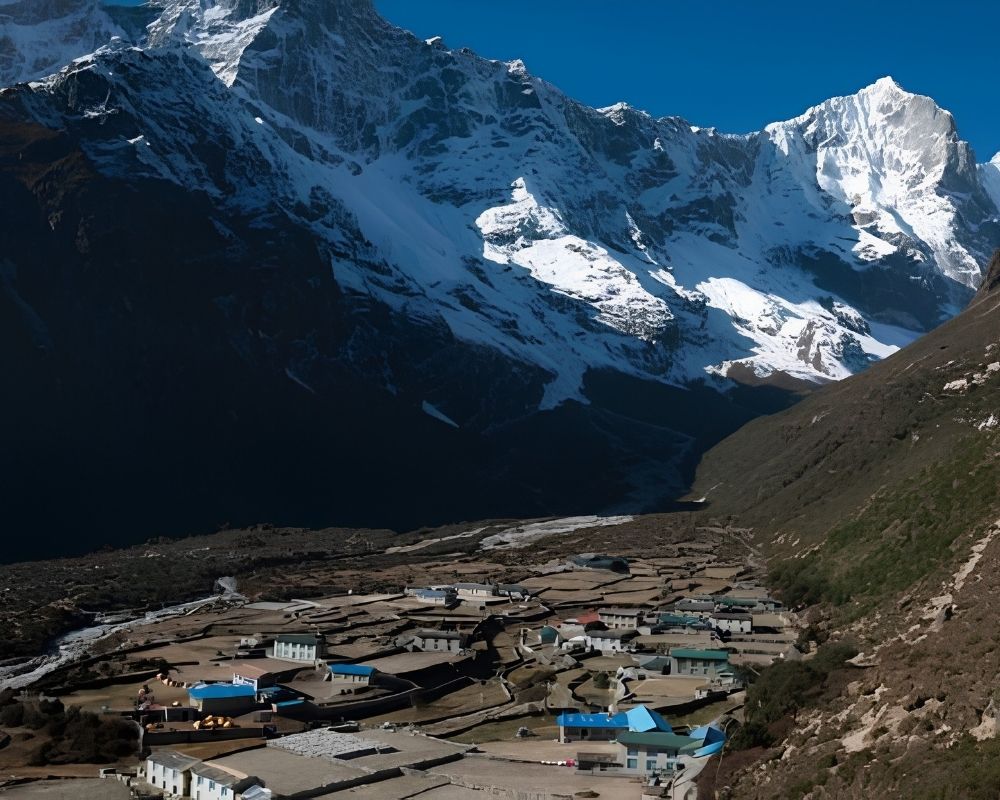
Thame village, Solukhumbu, Nepal
His father, Mingma Chiri Sherpa, was among the first professional Sherpa guides in the Everest region after Nepal opened its borders to foreign mountaineers in 1950.So from childhood, Kami Rita understood that the mountains were both home and livelihood. The Sherpas deeply honor Everest, known as “Sagarmatha” in Nepali and “Chomolungma” in Tibetan, as a sacred spirit, not merely a summit. This deep respect would shape everything about how Kami Rita would come to climb.
02 - THE CLIMB BEGINS
From porter to guide: learning the mountain
Kami Rita entered the mountaineering industry in 1992, beginning as a porter and base camp cook's assistant the demanding and often overlooked foundation of Himalayan expedition work. He carried loads, set ropes, and watched more experienced climbers from below. Two years later, in 1994, he stood on top of the world for the first time at age 24.
What might have been a singular achievement became a pattern. Season after season, spring after spring, Kami Rita returned not chasing glory, but answering the call of professional duty and, perhaps more deeply, the call of the mountains themselves. His brother, Lakpa Rita, would go on to summit Everest 17 times. Records, it seems, run in the family.
"Climbing mountains is my profession, and I do it for a living."
KAMI RITA SHERPA
What makes Kami Rita truly remarkable is how little ego he carries despite everything he's accomplished. The world throws labels like "greatest" and "record breaker" at him, but he always turns the spotlight back toward the mountain and his people. It's a kind of humility that feels rare and, more importantly, completely real.
03 - THE RECORD
32 ascents, and a number that keeps growing
On May 17, 2026, at 10:12 a.m. Nepal time, Kami Rita Sherpa reached the summit of Mount Everest for the 32nd time, leading an expedition organized by 14 Peaks Expedition. The ascent was confirmed by Nepal's Department of Tourism field office at Everest Base Camp. He broke his own record of 31 ascents, which he had set barely a year earlier in May 2025.
The numbers behind the man are staggering. His total verified 8,000 meter summit count now exceeds 43, including eight ascents of Cho Oyu, multiple summits of Manaslu, one of Lhotse, and one of K2 considered by many climbers to be a far more technically demanding peak than Everest itself. In 2025, Guinness World Records formally recognized him for the most true summit ascents of 8,000 meter peaks by any individual in mountaineering history. On the same morning as his 32nd Everest summit, Lhakpa Sherpa known as the "Mountain Queen" reached the top for her 11th time, making May 17, 2026 a landmark day for Nepali climbing.
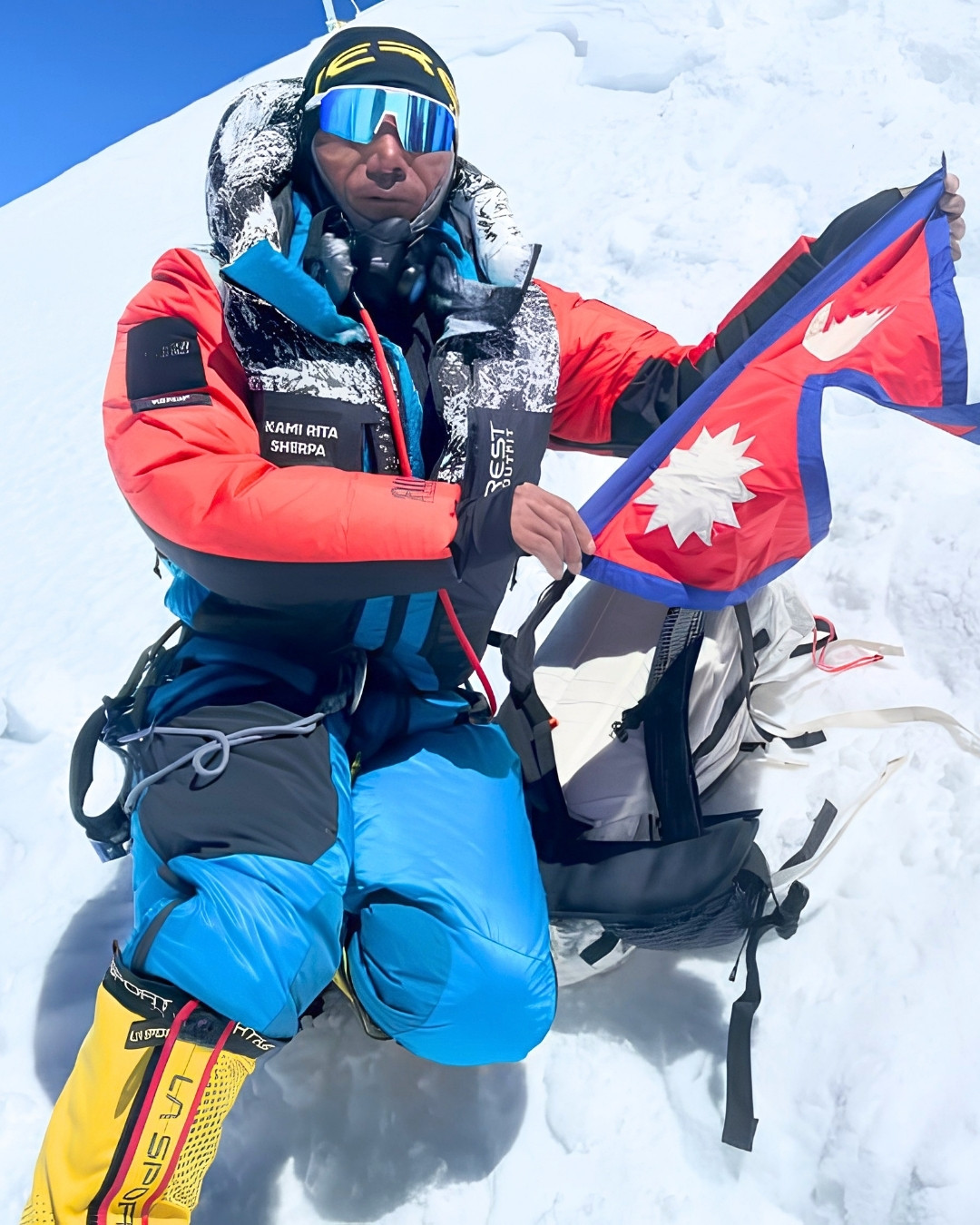
Summit Milestones
1994 - First Everest summit, via Southeast Ridge, age 24
2018 - Becomes the first person to summit Everest 22 times; begins holding the record continuously.
2023 - Completes two ascents in a single season (27th and 28th)
2025 - Guinness recogniton for most 8,000m true summits; 31st Everest ascent
17th may 2026 - 32nd summit,10:12am. Nepal Time
04 - THE RISK
Danger is not a metaphor on Everest
Every single one of those 32 ascents carried genuine risk of death. Everest's notorious Khumbu Icefall, a shifting, cracking maze of glacial ice blocks must be crossed multiple times on each expedition. Hidden openings appear without warning. Avalanches descend in silence. At 8,000 meters, the human body begins to break down no matter how fit or experienced the climber.
Kami Rita has spoken plainly about these realities. "The hidden openings are deep and the slopes are unpredictable," he told reporters. Despite improvements in equipment and weather forecasting, the occupation remains dangerous. About one out of every three deaths on Everest is a Sherpa. This sobering statistic rarely makes headlines, yet it frames Kami Rita's achievement in a very different light.
He also raised a painful issue in 2018: when veteran climber Ang Rita Sherpa was hospitalized with a brain hemorrhage, the government provided no support. The men who make Everest tourism possible are not always treated with the dignity their sacrifice demands.
05 - THE BURDEN
Everest as economy, and as wound
Nepal's economy depends heavily on mountaineering tourism. Everest permits alone generate millions of dollars annually for the government, and the ecosystem of guides, porters, tea house owners, and logistics companies that supports each expedition represents the livelihood of thousands of families in Solukhumbu and beyond.
But the mountain is paying a cost. Decades of high traffic expeditions have left behind tents, ropes, gas canisters, human waste, and the frozen bodies of those who did not return. The so called "death zone" above 8,000 meters has become an unintentional archive of human ambition and its wreckage. Climate change is accelerating the problem glaciers are retreating, exposing debris that was previously locked in ice, and destabilizing the routes that Sherpas have navigated for generations.
This tension between the economic necessity of tourism and its environmental cost is the central dilemma of modern Everest. Kami Rita stands directly at its intersection, embodying both the value of the industry and the urgency of reforming it.
06 - RECOGNITION
Nepal celebrates, but the Sherpa community asks for more
After his 32nd summit, Nepal's Department of Tourism issued a formal statement praising his contribution to the country's mountaineering sector. Nepal's Prime Minister took to social media, calling the Sherpas "truly the unsung heroes of the Himalayas" and describing Everest as "the supreme symbol of Nepal's self respect, courage, patience, and Himalayan civilisation."
The praise from political circles was warm. But Kami Rita and others in the Sherpa community have long pointed out that recognition in words must eventually become recognition in wages, insurance, safety standards, and institutional support. Praise without policy changes little for the Sherpa guide who crosses the Khumbu Icefall at 2 a.m. to fix ropes for a foreign expedition.
07 - STEWARDSHIP
Clean Himalayas: the mountain as responsibility
Among his many roles, Kami Rita has emerged as an advocate for environmental stewardship in the Himalayas. He is associated with the Clean Himalayas Initiative, a conservation effort that partners local organizations and international teams to remove discarded equipment, waste, and human refuse from Everest Base Camp and its surrounding terrain.
He has spoken openly about climate change's effect on the glaciers he has climbed for over three decades receding ice, shifting crevasses, and the destabilization of routes that Sherpas have navigated for generations. His mentorship of young Sherpa climbers includes an emphasis on environmental awareness and responsible climbing practices, ensuring that the next generation of guides approaches the mountains with both technical skill and ecological conscience.
His vision, as stated on his own platform, is to maintain the integrity of Mount Everest for future generations of climbers and adventurers. It is a statement that carries particular weight coming from a man who has stood on its summit more times than any human alive.
08 - PHILOSOPHY
He climbs for work, not for records
Perhaps the most striking thing about Kami Rita Sherpa is what he does not say. He does not speak about legacy. He does not describe himself as a record breaker. He does not perform the language of ambition that the Western mountaineering world has come to expect from its heroes.
Instead, he says: "There is a close bond between the mountain and the Sherpa." He says climbing is his profession. He says he does it for his family, and for the Sherpa people. The records accumulate not because he is chasing them, but because he keeps doing his job with an almost calm consistency that speaks more loudly than any summit speech.
Ang Tshering Sherpa, past president of the Nepal Mountaineering Association, put it well: "Kami Rita is not only a strong climber, but he also has good technical skills." It is a quiet assessment of a quiet man and it is enough.
"Without their courage, knowledge, and labour, the glory of the mountains remains incomplete."
Nepal's Prime Minister
Built with pride by
It is a honor we hold with genuine pride having had the opportunity to build the official digital home for Kami Rita Sherpa, the most accomplished high altitude mountaineer in history. Translating a life of such extraordinary depth into a website required more than technical execution; it called for a careful understanding of his story, his values, and his standing as both a national icon and a global figure in mountaineering. We are honoured to have been trusted with that responsibility.
The website kamiritasherpa.com serves as the central platform for his expeditions, guiding services, environmental initiatives, and public engagements. It stands as a testament to the man himself: purposeful, grounded, and built to endure.
Sales & Marketing, Rewa Soft